CPCB certification for commercial production and marketing of compostable products was received in June 2021.
Less material. More possibility.
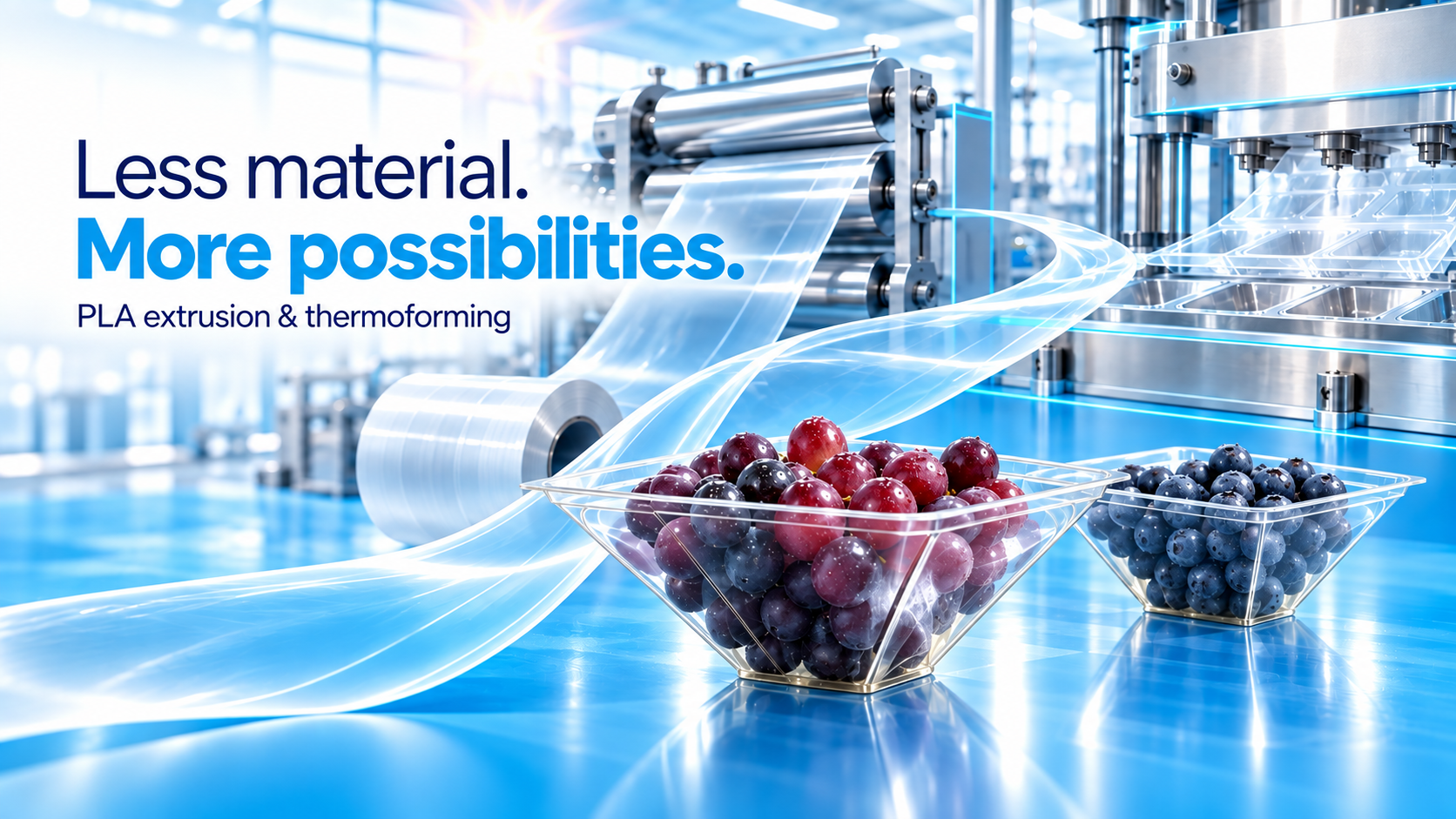
We engineer practical food-packaging solutions that help brands protect products, improve logistics and move toward a lower-impact material future.
Since 2018Bioplastics development journey
175–1300 mlQ‑Bic capacity range
In-houseExtrusion & thermoforming
ECOPCPCB seller identification code
Our eco DNA
Purpose-built for compostable packaging.
Ecopak began its bioplastics development programme in 2018 in the environmentally sensitive Dahanu–Talasari region of Maharashtra. The company specialises in bio-based and compostable sheet extrusion and thermoformed packaging, with a focus on technically practical and commercially effective solutions.
Our aim is to reduce dependence on fossil resources, lower packaging impact and create credible alternative end-of-life pathways—without losing sight of product protection, machinability and affordability.
Dedicated extrusion lines for bio-based plastics supported by pressure-forming and thermoforming capability.
Product documentation references EN 13432, ISO 17088 and ASTM D6400, supported by application-specific verification.
CPCB seller code “ECOP,” with QR-based product identification used in line with applicable guidelines.
Packaging for food
that needs to move.
From the first material trial to a production-ready pack, Ecopak brings design, sheet extrusion, thermoforming and application testing into one practical development path.
01
Fresh produce
Clear, lightweight punnets and trays designed around visibility, ventilation, cold-chain handling and shelf presentation.
Berries • grapes • cut fruit02
Ready-to-eat
Compact formats for portioned foods, snack combinations and products that need efficient secondary packaging.
Arils • snacks • prepared foods03
Dairy & frozen
Packaging development for yoghurt, ice cream and multipacks—balancing filling, sealing, brand presence and logistics.
Yoghurt • ice cream • dairy04
PLA rigid sheet
Transparent PLA sheet rolls manufactured for thermoforming trials and commercial packaging applications.
Sheet extrusion05
Custom development
Application-led concepts, prototypes, tooling coordination and testing support for new sustainable formats.
Concept to scale06
Pet food
Format exploration for portion control, product protection and shelf-efficient pet food packaging.
Wet food • treatsCompostability,
explained clearly.
Compostable packaging is designed for biological treatment in an appropriate, active composting environment. Certification, correct labelling and access to a suitable collection route are essential parts of the system.
01
Designed for use
The pack must first protect the product through filling, storage, transport and sale. Performance during use remains the starting point.
02
Collected correctly
After use, the pack must enter the intended organics or composting route—not conventional plastic recycling or uncontrolled disposal.
03
Biological breakdown
Under defined composting conditions, microorganisms convert certified compostable material into carbon dioxide, water, biomass and mineral residues.
Material and pack advantages
- Lightweight and resistant to breakage
- Strong, tear-resistant structures can be engineered
- Water and moisture resistance for suitable food applications
- Transparent presentation for product visibility
Circular design principles
- Use only the material required for product protection
- Keep products and materials at their highest useful value
- Design the pack around its intended end-of-life route
- Validate the complete tray, lidding and label system
Important: “Compostable” does not mean a product will disappear in every environment. Disposal claims depend on certification, local infrastructure and the conditions defined for the complete packaging system.
“Sustainability works when the packaging also works—for the product, the line and the supply chain.”
— The Ecopak approach
1
Understand the product
Fill weight, shelf life, storage conditions, sealing method, distribution route and retail environment.
2
Engineer the pack
Material, geometry, thickness, ventilation, lidding and secondary-pack configuration.
3
Test before release
Machine compatibility, seal integrity, load performance and real-condition product trials.
4
Scale responsibly
Tooling, manufacturing readiness, quality documentation and commercial supply planning.
Start a packaging conversation
Bring us the product. We’ll help shape the pack.
Tell us what you pack, the fill weight and where it needs to travel. Our team will respond with the right next step.
office@ecopak.co.in →Factory: Plot No. 41, Achaad Industrial Estate, Talasari, Palghar, Maharashtra.
On the Mumbai–Ahmedabad corridor, with access to Vapi, Vasai and Boisar logistics hubs.
Phone: +91 99204 99496